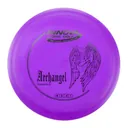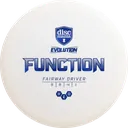
The F9 is the most understable fairway driver in Prodigy's lineup, rated 8/6/-4/0.5: deep turn, big glide, and almost no fade, which makes it the brand's dedicated hyzer-flip, turnover, and roller tool. Slower arms get honest distance from it; faster arms get shot-shaping freedom. Prodigy's F series runs from overstable to understable as the numbers climb, and the F9 anchors the flippy end. It sells in the brand's numbered plastics, with 400 the premium standard, 500 grippier and firmer, and 300 the softest of the trio listed here. If your fairway drivers all fade out early, this is the correction: let it turn, let it ride, and save the flex lines for something beefier.
The F9 is the most understable fairway driver in Prodigy's lineup, rated 8/6/-4/0.5: deep turn, big glide, and almost no fade, which makes it the brand's dedicated hyzer-flip, turnover, and roller tool. Slower arms get honest distance from it; faster arms get shot-shaping freedom.
Prodigy's F series runs from overstable to understable as the numbers climb, and the F9 anchors the flippy end. It sells in the brand's numbered plastics, with 400 the premium standard, 500 grippier and firmer, and 300 the softest of the trio listed here.
If your fairway drivers all fade out early, this is the correction: let it turn, let it ride, and save the flex lines for something beefier.
Flight
Source: Prodigy
500'0'50'100'150'200'250'300'350'400'450'500'
LeftRight
Arm speed
NoviceIntermediatePro
SpeedHow hard the disc must be thrown to fly as designed. Putters are 1 to 3, the fastest drivers 14 and up.
8
GlideHow long the disc stays in the air. More glide means more distance from the same throw.
6
TurnHow much it drifts right early in flight (right-handed backhand). More negative, more drift.
-4
FadeHow hard it hooks left as it slows down (right-handed backhand). Higher, stronger hook.
0.5
StabilityTurn plus fade. Negative drifts right and is easier for beginners. Positive finishes left.Turn + Fade
-3.5
Dimensions
Source: PDGA
DiameterHow wide the disc is, edge to edge. Almost every disc is 21 to 22 cm.
21.1 cm
HeightHow tall the disc is lying flat. Putters are usually the tallest.
1.9 cm
Rim DepthHow deep the rim is underneath, where your fingers grip. Putters have the deepest rims.
1.1 cm
Rim ThicknessHow wide the rim is. Wider rims make faster discs that need a stronger throw.
1.8 cm
Rim Inside DiameterThe width of the flat middle, inside the rim. Bigger usually means a slower, easier disc.
17.5 cm
Rim Depth/Diameter RatioRim depth as a share of the disc's width. Higher means a deeper rim for its size.
5.2%
Rim ConfigurationA PDGA score for the shape of the edge. Low is sharp, like a driver. High is rounded, like a putter.
31.5
BeadA small ridge under the edge of the rim, mostly on putters. It changes how the disc feels in hand.
Yes, it is one of the best fairway drivers for new and lower-power players. Its understable flight and glide make it easy to get distance without a lot of arm speed, and it hyzer-flips to flat and holds turnover lines with little effort. Stronger players use it for rollers and big anhyzers.
TryDiscs ·July 18, 2026
What is the F9 best used for?
Turnovers, hyzer flips, rollers, and easy distance. Its high turn and minimal fade make it great for shaping right-turning lines (for a right-handed backhand throw) and for players learning roller shots. It is not a wind-fighter, but for controlled turnover distance it excels.
TryDiscs ·July 18, 2026
Reviews
star4.7·80 reviews from 6 stores
Try Discs adds up reviews from six disc golf stores, so you see what players think across stores, not just at one shop. Reviews are great for spotting proven, popular discs. Take the details with a grain of salt, though: runs, plastics and skill level all change how a disc flies, so your experience may vary.