
Hammer
DISCONTINUEDPutt & Approach
shopping_bagWhere to buy table_chartCompare similar discs show_chartView flight matrix table_chartCompare similar discs
more_horiz
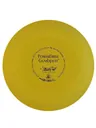
The Hammer is another example of a name that Innova used on multiple molds, 3 to be exact. The original version of the Hammer was a putter mold released around 1986-7 and simply were beaded Aces. Aces themselves are obscure discs, but as a modern reference, Aces resemble Darts. (Note, the Ace I am referring to here is the putter mold from the 1980s, not the Wal-Mart exclusive) When referring to the original version of the Hammer these days, we usually call them “Classic Hammers” as that’s how they are sold on the Innova Pro Shop. The second generation of the Hammer was a midrange mold that came around 1988. Second generation Hammers have a Roc bottom and a Shark top. These were the most popular variant of the Hammer and were around until the early 1990s. Third generation Hammers were faster and a bit more concave and marketed as “Hammerhead” Hammers. However, Innova did not make many of these and they are quite rare. Both 2nd and 3rd generation Hammers were designed such that most of the discs weight lied on the outside edge instead of being distributed evenly throughout the disc. This uneven distribution was to make the Hammer more durable; and remember, the only plastic available at the time was DX. So, tricks like this and adding beads were the only tools Innova had to increase durability. As Millennium and premium plastics came around, gimmick discs like the Hammer became obsolete and the Hammer went out of production.
The Hammer is another example of a name that Innova used on multiple molds, 3 to be exact. The original version of the Hammer was a putter mold released around 1986-7 and simply were beaded Aces. Aces themselves are obscure discs, but as a modern reference, Aces resemble Darts. (Note, the Ace I am referring to here is the putter mold from the 1980s, not the Wal-Mart exclusive) When referring to the original version of the Hammer these days, we usually call them “Classic Hammers” as that’s how they are sold on the Innova Pro Shop.
The second generation of the Hammer was a midrange mold that came around 1988. Second generation Hammers have a Roc bottom and a Shark top. These were the most popular variant of the Hammer and were around until the early 1990s. Third generation Hammers were faster and a bit more concave and marketed as “Hammerhead” Hammers. However, Innova did not make many of these and they are quite rare.
Both 2nd and 3rd generation Hammers were designed such that most of the discs weight lied on the outside edge instead of being distributed evenly throughout the disc. This uneven distribution was to make the Hammer more durable; and remember, the only plastic available at the time was DX. So, tricks like this and adding beads were the only tools Innova had to increase durability. As Millennium and premium plastics came around, gimmick discs like the Hammer became obsolete and the Hammer went out of production.
Want something like the Hammer?
Describe what you’d change and get disc suggestions.
Flight
Source: InnovaSpeedHow hard the disc must be thrown to fly as designed. Putters are 1 to 3, the fastest drivers 14 and up.
2
GlideHow long the disc stays in the air. More glide means more distance from the same throw.
2
TurnHow much it drifts right early in flight (right-handed backhand). More negative, more drift.
-1
FadeHow hard it hooks left as it slows down (right-handed backhand). Higher, stronger hook.
2
StabilityTurn plus fade. Negative drifts right and is easier for beginners. Positive finishes left.Turn + Fade
1
Dimensions
Source: PDGADiameterHow wide the disc is, edge to edge. Almost every disc is 21 to 22 cm.
21.7 cm
HeightHow tall the disc is lying flat. Putters are usually the tallest.
2.1 cm
Rim DepthHow deep the rim is underneath, where your fingers grip. Putters have the deepest rims.
1.1 cm
Rim ThicknessHow wide the rim is. Wider rims make faster discs that need a stronger throw.
1.2 cm
Rim Inside DiameterThe width of the flat middle, inside the rim. Bigger usually means a slower, easier disc.
19.3 cm
Rim Depth/Diameter RatioRim depth as a share of the disc's width. Higher means a deeper rim for its size.
5.1%
Rim ConfigurationA PDGA score for the shape of the edge. Low is sharp, like a driver. High is rounded, like a putter.
36.75
BeadA small ridge under the edge of the rim, mostly on putters. It changes how the disc feels in hand.
No
Stores with Inventory Now
Plastics
Similar Discs
- Speed2Glide2Turn0Fade2Stability2Diameter21.5Height2.6Rim depth1.2Rim Width1.3Inside rim diameter18.9Rim diameter ratio5.6Rim configuration38BeadNo
- Speed5Glide5Turn-1Fade2Stability1Diameter21.7Height2Rim depth1.1Rim Width1.2Inside rim diameter19.3Rim diameter ratio5.1Rim configuration35.25BeadNo
- Speed4Glide5Turn-2Fade2Stability0Diameter21.7Height2Rim depth1.1Rim Width1.2Inside rim diameter19.3Rim diameter ratio5.1Rim configuration35.25BeadNo

Videos
Questions
Reviews
2 reviews from 1 store
The Innova Hammer has only 2 reviews so far, so one opinion can swing the picture. That's why there's no star average yet.
Try Discs adds up reviews from six disc golf stores, so you see what players think across stores, not just at one shop. Reviews are great for spotting proven, popular discs. Take the details with a grain of salt, though: runs, plastics and skill level all change how a disc flies, so your experience may vary.
Compare it with discs you already throwchevron_rightFrom 1 store
Ratings and counts come from each store's own customer reviews.